
- وزير النقل وزير العمل نضال القطامين يقرر تمديد ساعات الدوام الرسمي في مكاتب ومديريات العمل اعتبارا من السبت 12 أيلول 2026 وحتى الأربعاء 30 أيلول، لتستمر من السبت حتى الخميس حتى الساعة الـ5 مساءً
- إدارة السير تعلن عن تطبيق خطة مرورية مختلفة خلال الفترة المسائية من الخميس، تشمل مراحل ما بعد الظهيرة والفترة المسائية وما بعد العشاء
- إرسال طائرة إخلاء طبي جوي، مزودة بطاقم طبي متخصص من طبابة سلاح الجو الملكي، لإخلاء أردني يبلغ من العمر (27) عامًا من الإمارات ، إثر تعرضه لحادث سير
- استشهاد 4 فلسطينيين وإصابة آخرين، الخميس، إثر قصف قوات الاحتلال الإسرائيلي منزلا في مشروع بيت لاهيا شمالي قطاع غزة.
- المتحدث الرسمي باسم قوات التحالف "تحالف دعم الشرعية في اليمن"، اللواء تركي المالكي، يقول إن الحوثيين نفذوا الأربعاء هجمات باتجاه 3 مدن سعودية
- مجلس محافظي الوكالة الدولية للطاقة الذرية، يقرر الأربعاء، إغلاق الملف المتصل بعدم وفاء سوريا بالتزاماتها
- تسود أجواء معتدلة نهارا في أغلب مناطق المملكة، الخميس، فيما تكون حارّة في البادية والأغوار والبحر الميت والعقبة
Demands of Ajloun Residents Top 'Maidani' Discussions: Health, Water, Roads, and Education Sectors Need Real Achievement, Not Renewed Promises

04/07/2026 - 14:57
In an extensive episode that brought together a selection of Ajloun governorate residents, specialists, and academics, the "Maidani" program on Radio Al-Balad 92.5 FM hosted a rich panel discussion monitoring the governorate's reality nearly a year after the Cabinet's visit, led by Prime Minister Dr. Bisher Al-Khasawneh, to Ajloun last April. The discussion focused on the directives, development projects, and service projects launched during that session that were supposed to be completed or progressed on during 2025 and beyond.
The program was presented by media personality Mamdouh Al-Hanahneh, with participants including former MP Dr. Salma Al-Rabadhi, Chairman of the Board of Trustees of Ajloun National University Dr. Muhammad Nour Al-Smadi, and economic advisor Dr. Ali Youssef Al-Momani, alongside a broad community attendance from the governorate's residents who enriched the discussion with their direct field testimonies.
Health Sector: Advanced Buildings and Lagging Staff
The session opened the health sector file wide, with official figures indicating an 85% completion rate in this sector. While the guests did not formally object to this number, they unanimously agreed that it does not fully reflect the lived reality.
Dr. Salma Al-Rabadhi, a former advisory member in Ajloun Governorate since 1994, stated that the journey of demanding Ajloun's health projects spans decades. She pointed out that Al-Iman Public Hospital is considered today one of the most modern hospitals in the Kingdom in terms of construction and equipment, yet it severely lacks specialized medical staff. She added: "We took a wonderful building and an excellent structure, but why don't we prepare the human resources of specialist doctors and nursing staff? A patient today is referred to Amman because the specialist is not present in Ajloun, so what is the use of the building if there is no one there to treat people?"
Dr. Al-Rabadhi called for activating doctor scholarship programs to obtain specializations, stressing that this is the only radical solution, saying: "The old Baptist Hospital covered all of Ajloun's needs, and no one needed to travel to Amman. So how can a modern, equipped hospital not achieve what an old hospital did?"
Dr. Muhammad Al-Smadi confirmed that Ajloun Hospital's needs center on two basic points: first, providing qualified specialized staff, and second, converting the hospital into a teaching hospital. He pointed out that there was an agreement with Yarmouk University and the Faculty of Medicine to convert the hospital into a training center to receive resident doctors in their specializations under the supervision of academic professors, calling for the reactivation of this agreement, as this would be a real medical qualitative leap that serves the patient and develops the health service in the governorate at once.
The session witnessed vibrant community interaction, as one attendee from the governorate's residents pointed out that the hospital possesses sophisticated equipment that the staff in charge of it are unable to fully use, which results in the patient ultimately being referred to hospitals outside the governorate despite the equipment being in front of them, in a scene that summarizes the competence crisis, not the equipment crisis.
Regarding health centers, figures indicated a government commitment to constructing three new health centers in Ba'oun, San'ar, and Halawa at a cost of nearly two and a half million dinars, as well as establishing a comprehensive health center for Ajloun city at a cost of one million dinars, with expectations for its completion during 2026. Dr. Al-Momani saw the distribution of these centers as relatively fair because it targets less fortunate areas, but he stressed the necessity for these centers to rise to advanced standards that meet daily and basic medical needs, not just be buildings lacking competence.
Water Crisis: The Rainiest Governorate Lives Summer Thirst
The water file commanded a lengthy discussion, and it contained a striking irony pointed out by everyone: Ajloun is the first governorate in the Kingdom in terms of rainfall rates, yet its residents suffer from severe water cuts, with water only reaching some areas once every two weeks or more, and for limited hours.
Dr. Al-Momani said that the completion rate in the water sector recorded its lowest levels compared to other sectors, not exceeding 30% despite allocating one million three hundred and ninety thousand dinars to it in last year's budget, pointing out that this stutter casts its direct shadow over the investment and tourism environment in the governorate. He added that about 60% of the governorate's area is not served by sewage networks, which raises groundwater pollution rates, which he described as a "wrong water policy" in a governorate that leads the Kingdom in rainfall.
Dr. Al-Smadi revealed that as the first head of the Ajloun Governorate Council, he submitted a project to the government that received approval and was submitted to Italian funding agencies. Over 85% of it has been completed so far, aimed at extending a conveyor line from the Kafranja Dam to high areas like 'Anjara, along with constructing a tank and a desalination station, thereby allowing water to be distributed smoothly to lower areas. He explained that what remains of the project includes installing pumps and completing some infrastructure works, appealing to the Ministry of Environment to release financial dues to contractors to complete what remains.
Dr. Al-Rabadhi pointed out that Kafranja Dam is considered the only one in the Kingdom that does not fill to its full capacity, explaining that the reason lies in its tributaries from the surrounding mountains and villages being drained by farmers to irrigate their lands before they reach the dam, and also that the nature of the soil in Ajloun absorbs a large percentage of rainwater. She suggested supporting individual water harvesting projects and encouraging families to dig wells and supporting them financially, citing her personal experience of owning a well in her home that spares her from waiting for government water throughout the winter season.
Al-Smadi emphasized that the sewage project in the Junaid region is the most urgent in the governorate's needs directory, explaining that plans have been ready for over twenty years and nothing impedes its implementation except "government excuses" unacceptable to the governorate's residents, considering its completion an urgent environmental necessity to stop groundwater and spring pollution.
A number of attendees from the residents of 'Anjara complained that water network renewal projects left the streets cut up with excavations not restored to their original state, as contractors resort to backfilling excavations with earth and a superficial asphalt layer without rebuilding the road to its original specifications, which they demanded be followed up on and those negligent held accountable.
Roads and Infrastructure: A Confined Artery in a Mountainous Body
The guests did not differ in diagnosing the road crisis in Ajloun, as they unanimously agreed that it is one of the deepest challenges facing the governorate, and that most main roads still exist on their old structure that has not developed for four decades or more.
Dr. Al-Momani said that the road connecting Ajloun to Jerash and extending towards Amman still remains a single track for over fifty years, without widening or development befitting a governorate considered a national tourism destination. He pointed out that establishing the cable car project in the Castle and Ishtafina area created an urgent need to establish a road connecting Irbid to Amman passing through Ishtafina region, which was approved during the Prime Minister's visit to Ajloun, demanding speed in its implementation.
Dr. Al-Smadi spoke about the new road project extending from the Qafqafa triangle to the Ishtafina intersection at a cost of five million dinars, saying he reviewed its plans and they are "very good and free of sharp curves," appealing to the Minister of Public Works and His Excellency the Prime Minister to speed up its implementation, considering it a main artery that will transform Ajloun into a vital station on the travel route between the North and the capital.
He also pointed to the Ajloun - Kafranja - Wadi Al-Tawahin road project, saying that this road, which cuts the distance between the two largest population centers in the governorate from 12 kilometers to 4.5 kilometers, holds exceptional touristic and agricultural value given the springs and old mills it passes through. However, he pointed out that the Ministry of Works' haste in implementing part of it without sufficient hydrological and geotechnical study led to collapses and water flows from which residents suffered, demanding re-implementation of the entire project to the highest engineering standards.
Dr. Al-Rabadhi stressed the necessity that specifications for agricultural roads in Ajloun be different from those adopted in other governorates with a plain nature, pointing out that an agricultural road implemented in Ajloun may be damaged by the first winter if the specificity of the mountainous terrain is not taken into account in its infrastructure, meaning recurrent waste of maintenance allocations. She asked: "Why do we make an agricultural road in summer and then the first rains wash it away?"
A number of Ajloun residents called for finding a radical solution to the traffic congestion inside Ajloun city, especially on Fridays when the city's streets turn into something resembling complete paralysis, with sidewalks and side streets occupied by vendors and large vehicles, suggesting transforming the main street to one-way traffic along with finding a parallel road, solutions they confirm were officially submitted years ago without response.
Education and Vocational Training: Lagging Buildings and Neglected Teachers
In the education file, the session revealed that the completion rate of educational projects reached 70% according to official figures, and that the government promised to construct nine new schools during 2025 and 2026, in addition to a vocational school keeping pace with future labor market requirements.
However, Dr. Al-Smadi pointed out that most of these projects were listed before the formation of the current government, and some remain stumbling, foremost among them the 'Ain Janna school whose completion rate reached between 50% and 90% then work stopped in it due to contractual disputes, demanding quick measures surpassing bureaucratic routine to complete it and hand it over. He added that regions like Kafranja, Junaid, Al-'Uyoun, and Al-Hashimiyya are in dire need of new schools, pointing to the importance of obtaining lands and laying plans beforehand so that the governorate is ready to receive any international grant and convert it immediately into a project on the ground.
Al-Smadi called for expanding vocational and technical education, pointing out that the only vocational school in Ajloun, which is King Abdullah School in 'Anjara, has come to suffer from severe overcrowding, and that the government promise to establish a second vocational school conforming with the National Strategy for Human Resource Development has not yet turned into reality, asking for vocational schools in the north and west of the governorate that accommodate youths from distant areas.
Dr. Al-Rabadhi expressed deep concern over the phenomenon of teachers on temporary contracts, pointing out that a teacher who does not feel belonging and job stability cannot give their students their due right. She also warned of the absence of justice in appointments at the Ministry of Education, as a 2007 graduate competes with this year's graduate in exams and interviews on equal footing despite the huge time difference, demanding the Minister of Education to reconsider the appointments system.
She also called for speed in activating the military culture school project for which land was allocated and its construction has not yet been completed, describing it as a distinguished educational experience where values, discipline, and order are instilled.
Dr. Al-Momani addressed the vocational training file, pointing out that vocational training centers in Ajloun represent an exceptional opportunity in the absence of a large industrial sector, and that introducing specializations for hybrid and electric cars is a step in the right direction, stressing that linking vocational training directly to the labor market is the most viable way to address youth unemployment, which constitutes one of the largest challenges the governorate faces.
Tourism and Investment: Cable Car Without an Integrated System
Participants pointed out that the cable car project, despite its importance, cannot alone constitute a real touristic lever unless supporting projects are completed, including visitor centers, hiking trails connecting the castle to the cable car station, and general service facilities. Dr. Al-Momani confirmed that the center of Ajloun city, which contains the Great Ajloun Mosque with its history extending over nine hundred years, deserves heritage-civilization development, and that keeping it in its current state wastes replaceable archaeological and touristic value.
Dr. Al-Smadi pointed to the existence of more than fifty touristic products in Ajloun which are individual initiatives by young men and women from the governorate's residents, calling on the government to support these initiatives financially and legally, qualify their owners, license their projects, and subject them to quality assurance standards to build a real tourist "brand" for Ajloun.
Dr. Al-Momani criticized the restrictions imposed on licensing touristic projects, as most are unlicensed because the roads leading to them do not meet the minimum required width, demanding special regulatory flexibility that takes into account the nature of mountainous areas, and opening up state lands, which represent 44% of the governorate's area, to touristic investment through special agreements.
Recommendations and Demands of Attendees from the Government
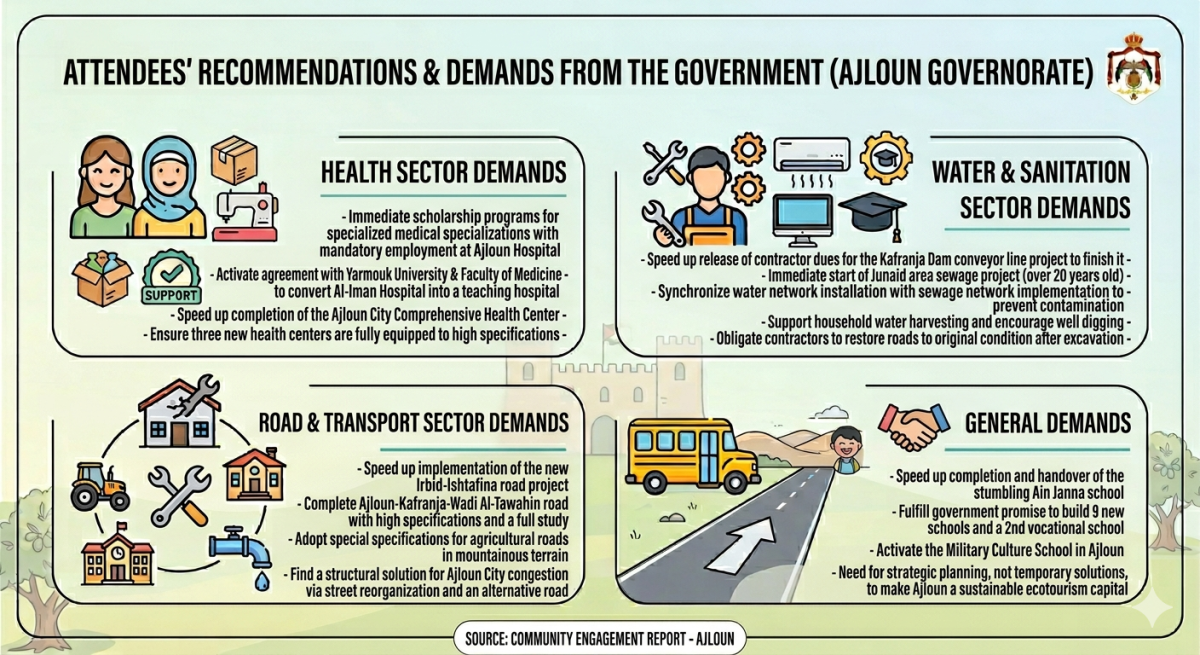
In conclusion, the session raised a number of explicit recommendations and demands called for by the guests and attendees from the governorate's residents, foremost among them:
In the Health Sector: Allocating immediate scholarship programs for Ajloun doctors to obtain multiple medical specializations and obligating them to work in the governorate's hospital, activating the agreement with Yarmouk University and the Faculty of Medicine to transform Al-Iman Hospital into a training teaching hospital, speeding up completion of the comprehensive health center for Ajloun city, and ensuring that the three new health centers are with true advanced standards, not just empty buildings.
In the Water Sector: Speeding up release of contractors' financial dues in the Kafranja Dam conveyor line project to finish what remains of the completion percentage, immediate commencement of the sewage project in Junaid region whose plans have exceeded twenty years in age, linking water network implementation to sewage networks simultaneously to avoid pollution, supporting household water harvesting projects and encouraging well digging and supporting them financially, and obligating contractors to restore roads to their state after excavation works.
In the Road Sector: Speeding up implementation of the new Irbid - Ishtafina road which has been studied and its plans prepared, completing the Ajloun - Kafranja - Wadi Al-Tawahin road with the highest engineering specifications and after sufficient hydrological and geotechnical study, adopting special specifications for agricultural roads that take into account Ajloun's mountainous nature, and serious search for a structural solution to Ajloun city's congestion through organizing streets and creating an alternative road.
In the Education and Training Sector: Speeding up finishing the stumbling 'Ain Janna school and handing it over to the Ministry of Education, implementing the government promise to construct nine new schools and the second vocational school, activating the military culture school in Ajloun, addressing the phenomenon of teachers on temporary contracts, and reconsidering the appointments system in the Ministry of Education to ensure justice among teachers.
In Tourism and Investment: Completing the second phase of the cable car project and establishing the central visitor center, developing heritage Ajloun city center, supporting individual tourist initiatives for governorate residents and licensing and qualifying their owners, making state lands available for tourist investment through clear agreements, and regulatory flexibility in requirements for licensing tourist projects.
On the General Level: Attendees demanded that the next Cabinet session in Ajloun be more popular and open to the local community and civic expertise, not limited to heads of official departments; that municipal files and performance levels be opened for objective accountability far from currying favor; and that government promises turn into binding timetables that are held accountable, emphasizing they do not want a "panic system" that temporarily silences people, but rather they want real strategic planning that transforms Ajloun into what the royal will wanted: a capital for ecotourism and a pole for sustainable development in the Jordanian North.
Government Commitments and Projects "Under Implementation" (2025-2026)
The government committed to a package of strategic projects within the "Ajloun Master Plan," and the most prominent what is being worked on now includes: ● Health Sector: The most prominent commitment is constructing a new building for the Ajloun Comprehensive Health Center, where the government directed to begin actual implementation during the year 2026 to address cracks and structural problems in the old building. ● Transport Sector: Launching the second phase of the public transport development project, which includes operating regular routes with modern buses connecting Ajloun to the capital Amman (within a package including 180 buses for governorates). ● Development of the Cable Car System: Commitment to completing "Phase Two" which includes constructing a pedestrian walkway connecting Ajloun Castle to the cable car station, and building a central visitor center at the entrance to activate tourist movement. ● Capital Budget: Approving the Ajloun Governorate Council budget for the year 2026 with a value close to 10.1 million dinars (according to Executive Council estimates), distributed over 16 service and development sectors.
What Has Been Actually Implemented and Achieved Up until early 2026, the government achieved tangible completion rates in several files:
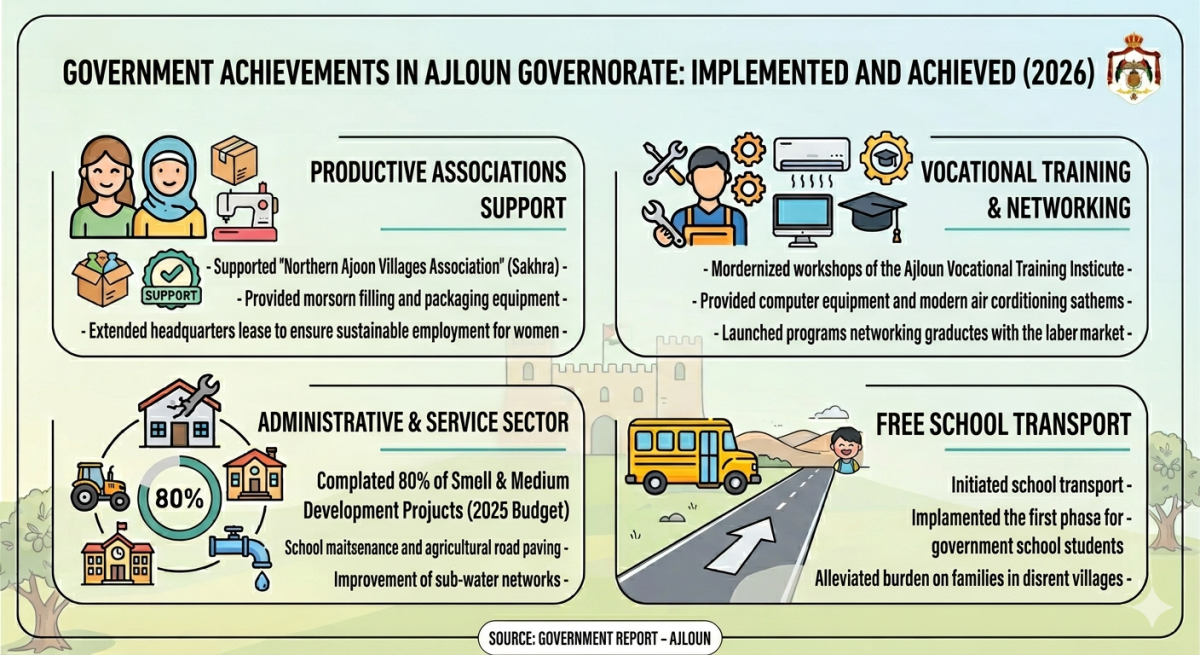
- Support for Productive Associations: Directives for supporting the "Northern Ajloun Villages Association" (Sakhra) were implemented by providing it with modern filling and packaging equipment and extending its headquarters lease to ensure sustainability of operating women.
- Vocational Training: Modernizing workshops of the Ajloun Vocational Training Institute and providing it with computers and air conditioning, with launching networking programs for graduates with the labor market.
- Administrative and Service Sector: Completion of what percentage constitutes 80% of small and medium development projects listed on the 2025 budget, which included maintenance of schools and agricultural roads and improving sub-water networks.
- School Transport: Beginning application of the first phase of the free school transport project for public school students, which relieved a large burden from off the shoulders of families in distant villages.