Is the "Yinon Plan" Being Implemented in Syria Today?

08/19/2025 - 13:39
الرابط المختصر
In February 1982, Israeli diplomat and journalist Oded Yinon published an article in the Hebrew magazine Kivunim under the title “A Strategy for Israel in the 1980s.”
What at first seemed like an internal intellectual paper aimed at Israel’s political elite later turned into a controversial reference point in academic and political debates about the future of the Middle East. Yinon presented a vision based on the idea that the Arab world, as shaped by colonial powers in the early twentieth century, was fragile and temporary. He argued that its fragmentation into small sectarian and ethnic entities represented a long-term Israeli strategic interest, as it would guarantee Israel’s military and political superiority and prevent the rise of any coherent regional threat.
Yinon did not hide his conviction that the states surrounding Israel were nothing more than a “house of cards” destined to collapse at the first real test, and that the ideal moment for Israel would be when these states became consumed by endless internal conflicts. He saw Lebanon as an early model of this process, warning that the rest of the Arab states—from Egypt to Iraq, Syria, and Jordan—were not immune to disintegration, as he claimed.
When it came to Syria specifically, Yinon considered it the most prominent example of an artificial state built on a sectarian and ethnic mosaic: Alawites, Sunnis, Kurds, Christians, and Druze. All of these, in his view, could transform into separate entities once internal conflict erupted.
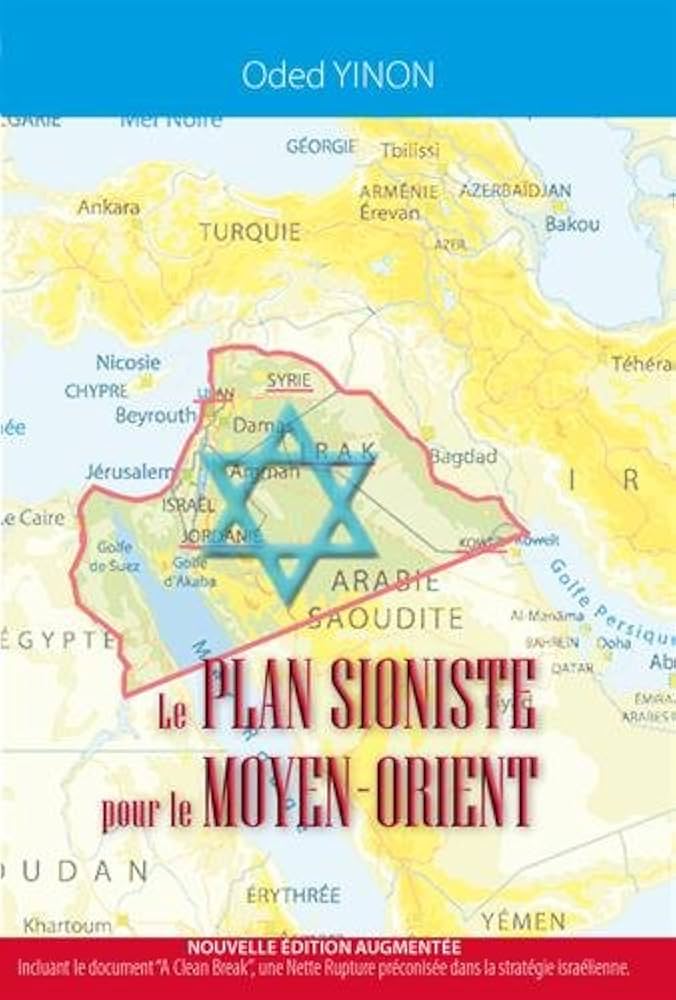
Today, more than four decades after that article was published, the Syrian war seems to have opened the door wide to this very scenario.
Since 2011, Syria has slid into a bloody and multifaceted conflict that resulted in the collapse of the centralized state as Syrians had known it since independence. The current Syrian map reveals a reality strikingly similar to what Yinon described: the northeast is effectively administered by a Kurdish authority backed by the U.S.; the Syrian regime maintains its grip on the west with support from Russia and Iran; opposition factions backed by Turkey control Idlib and parts of the northwest. Meanwhile, other areas have turned into zones of influence for local and international powers, with ISIS maintaining a fleeting presence before its military retreat. The result is that Syria, once a major regional player, has now become an open arena for power struggles.
It is easy to fall into the trap of interpreting these transformations as a literal implementation of the Yinon Plan.
However, the reality is more complex. The Syrian war originated primarily from internal dynamics: popular protests that were violently suppressed, their subsequent militarization, and then overlapping regional and international interventions. Yet what fuels the ongoing debate is that the end result bears a remarkable resemblance to the scenario Yinon outlined decades ago. The centralized Syrian state no longer exists in the traditional sense, and local entities defined by sectarian or ethnic identity have become an undeniable reality—even if not officially declared.
From Israel’s perspective, there is no doubt that the current situation serves a key aspect of its strategic security. Syria, once a conventional military threat, no longer exists. Instead, there is a patchwork of rival powers incapable of reaching agreement or unity. This fact alone raises questions about whether today’s developments are a historical coincidence—or the outcome of a long trajectory of policies anticipated, and perhaps even encouraged, by an article published in an Israeli magazine more than forty years ago.
Whether the Yinon Plan is seen as a strategic document ahead of its time or simply as a theory later exploited in conspiracy narratives, its relevance in today’s discussions about Syria cannot be ignored.
It provides an analytical framework to understand how the Syrian conflict evolved into a state of perpetual fragmentation, and how the Zionist project—perhaps without direct effort—has found itself at the heart of a geopolitical process redrawing the region along sectarian and ethnic lines, precisely as Yinon once imagined.