How Israel Lost the Social Media Battle؟
09/28/2025 - 12:37
الرابط المختصر
Since its establishment, Israel has relied on steadfast Western support, rooted in complex historical and political considerations. However, the large-scale aggression against Gaza that began in October 2023, accompanied by widespread devastation and civilian deaths, has shaken this support to unprecedented levels, creating a profound shift in Western public opinion.
The impact of this shift is now being reflected in government policies. Such a rapid transformation would not have been possible without the decisive role social media platforms played in breaking the monopoly of traditional narratives.
Initially, Western reactions, particularly in the United States and Europe, largely mirrored Israel’s stance, emphasizing "Israel’s right to self-defense" and urging strong backing for its military operations.
Yet, as the scale of killing and destruction escalated, along with policies of siege and starvation affecting civilians in Gaza, dissenting voices began to grow steadily within Western countries themselves.
The change in European attitudes has been striking. After months of alignment, key countries such as France, the United Kingdom, and even Germany—which carries deep historical sensitivities toward Israel—began amplifying criticism of Israeli policies.
These nations, alongside others including Spain, Ireland, Norway, and Slovenia, took bolder diplomatic steps, such as officially recognizing the State of Palestine. This move reflected an erosion of the protective cover the West had historically afforded Israel.
At the United Nations General Assembly, the vote demanding a humanitarian ceasefire saw a remarkable surge in support, including from Western allies of Washington and Tel Aviv, surprising observers and signaling a decline in international backing.
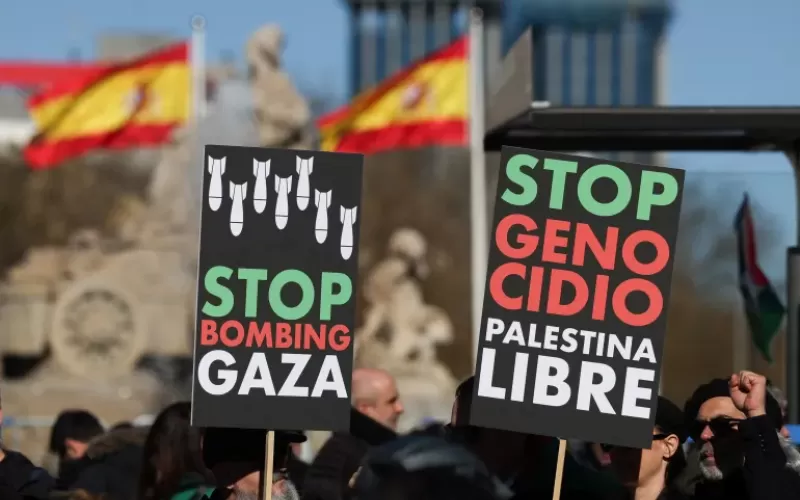
This official shift did not occur in isolation. It mirrored an unprecedented popular outcry. Pro-Palestinian demonstrations in major European capitals such as London, Berlin, and Paris exceeded in scale and consistency any prior movements.
The grassroots mobilization, spanning diverse age groups and social strata, exerted increasing pressure on governments. Polls in key European nations indicate that a substantial portion of citizens believe Israel overreacted, causing civilian casualties, and some even question whether Israel should have entered Gaza at all. Footage documenting the devastation and what are widely perceived as war crimes, captured around the clock, awakened European consciences and forced them to confront the long-standing Israeli narrative.
Central to this transformation is the role of social media platforms as both the engine and the main arena for this shift. While Western governments and traditional media initially adopted the Israeli narrative, social media has become a battleground beyond state censorship or editorial control.
Breaking the narrative monopoly, digital platforms—TikTok, Instagram, X, and others—enabled activists, Palestinian journalists, and sympathetic Arab and Western reporters to convey events directly, in real time, surpassing traditional media barriers. Scenes of bombardments, the deaths of children, famine, displacement, and destruction of residential neighborhoods reached millions of Western viewers, providing indisputable visual evidence that could not be countered by official statements or press releases.
Videos and photos taken on the ground played a crucial role in documenting what are suspected to be war crimes, some of which have even been used as evidence in South Africa’s submissions to the International Court of Justice.
Influencers and supporters of the Palestinian cause from various backgrounds helped amplify the narrative with immediacy and impact, transforming the digital landscape into a widespread arena of solidarity for Palestinians, reshaping global public opinion.
Faced with this overwhelming wave of changing public sentiment, the Israeli government realized it was losing the propaganda battle. Israeli messaging, initially grounded in the post-October 7 “victimhood” narrative, began to lose credibility as the war dragged on and civilian casualties mounted.
In a desperate attempt to regain control of the global narrative, news reports indicate that Israel poured vast sums into massive propaganda campaigns. Contracts worth millions were reportedly signed with digital giants such as Google and YouTube to promote political messaging favorable to Israel, showcasing it as a hub of technology, culture, and modernity, while downplaying topics like occupation and religion. Some reports suggest budgets reaching several million shekels dedicated to these campaigns.
Yet, despite these enormous efforts, the campaigns failed to achieve their objectives. The reason is simple: in the era of social media, paid propaganda cannot withstand the unfiltered truth broadcast in real time from smartphones on the ground. Images of "innovative Israel" cannot erase images of dead children and destroyed hospitals.
This crisis has demonstrated that the power of authentic, citizen-documented footage far outweighs even the largest governmental budgets allocated to image laundering.
The West’s pivot away from supporting Israel—first among the public and then at the governmental level—is a direct result of the tragic, real-time depiction of the "genocide" in Gaza, coupled with the transformative power of social media. These platforms turned Western citizens from passive information recipients into engaged witnesses, influencing global public opinion.
This modern media battle has exposed the falsehoods of Israel’s decades-long narrative. Netanyahu’s attempts to spend millions to "whitewash" Israel’s image have proven a losing proposition in the digital age: credibility and human empathy cannot be bought.
Today, the Palestinian narrative, propelled by social media, reaches every Western home. It represents a historic propaganda defeat for the occupation and a strong catalyst for political change, increasingly felt in capitals around the world.